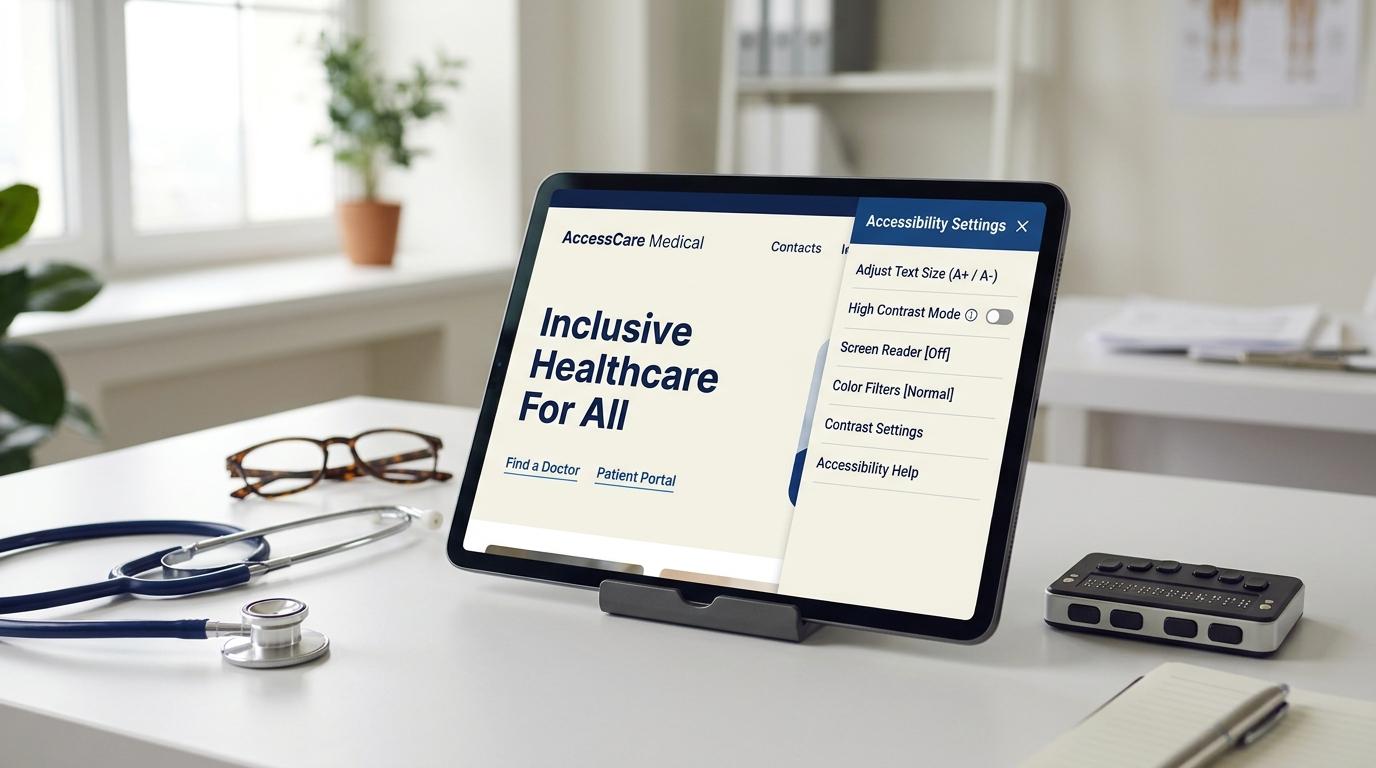

Section 504 website accessibility is the requirement that recipients of Department of Health and Human Services (HHS) financial assistance make web content and mobile apps meet Web Content Accessibility Guidelines (WCAG) 2.1 Level AA. The compliance dates are May 11, 2027 for recipients with 15 or more employees and May 10, 2028 for those with fewer than 15 employees.
Key takeaways
- Do not wait. HHS says it “fully anticipates implementing the regulation at the new deadline” if it issues no proposed rule on the substance of the regulation and no circumstances suggest further delay.
- Funding decides coverage. A private practice is covered when it receives HHS financial assistance, and headcount sets the compliance date, not coverage.
- Vendor tools count. The rule reaches web content a recipient provides or makes available directly or through contractual, licensing or other arrangements, so a vendor’s booking tool can fall inside it.
- Our screen is a lead, not a verdict. In our November 19, 2026 markup screen, 28 of 47 provider sites had at least one flagged item, most often a link without an accessible name.
- In our view, an overlay is not a plan. The rule text does not mention overlays (sections 84.82 to 84.89). In April 2025 the Federal Trade Commission (FTC) barred one vendor from claiming its automated products can make any website WCAG-compliant without evidence.
When is the Section 504 website accessibility deadline?
We advise against waiting. HHS’s interim final rule says the agency “fully anticipates implementing the regulation at the new deadline” if it issues no proposed rule on the 2024 final rule’s substance and no circumstances suggest further delay. The HHS press release states that recipients “are required to ensure that the web content and mobile apps they provide or make available are readily accessible to, and usable by, people with disabilities.”
The IFR is “limited to extending the 2024 final rule’s compliance dates,” so the WCAG 2.1 Level A and AA requirements stay in place. HHS also plans future rulemaking and says it “will consider issuing” a notice of proposed rulemaking (NPRM) that could include “changes that would affect the web content and mobile app accessibility requirements.” With 173 days left as of November 19, 2026, we treat May 11, 2027 as the planning date for practices with 15 or more employees.
What does Section 504 require for websites?
We advise testing every patient-facing page against WCAG 2.1 Level A and Level AA, because the HHS rule requires recipients to meet those success criteria once their compliance date arrives. The rule covers web content and mobile apps and states the general duty as keeping them “readily accessible to and usable by individuals with disabilities” (section 84.84).
WCAG 2.1 is published by the World Wide Web Consortium (W3C), and conformance at Level AA (the middle of its three levels) means satisfying all Level A and Level AA success criteria. Under the rule, a recipient that can demonstrate a fundamental alteration or undue financial and administrative burdens must still comply to the extent that doing so does not cause them (section 84.88).
Does Section 504 apply to private medical practices?
A private practice is covered when it receives HHS financial assistance. The rule defines a recipient to include any public or private entity or person to which that assistance is extended directly or through another recipient. We cannot tell whether a given practice receives it, so we advise confirming its status, for example Medicaid participation or any HHS grants, with counsel. This article is not legal advice.
An HHS FAQ on federal financial assistance lists health care providers participating in the Children’s Health Insurance Program (CHIP) and Medicaid among recipients of that assistance. The interim final rule likewise describes recipients as including “health care providers of all sizes, ranging from large hospital systems to small local clinics.”
HHS’s two FAQs do not agree on whether Medicare Part B counts. The FAQ reviewed in 2015 says “the receipt of Medicare Part B is not considered federal financial assistance,” while the FAQ reviewed in 2024 lists services covered under Part B among recipients. We take no position on a practice whose only HHS link is Part B coverage.
What Section 504 WCAG 2.1 Level AA requirements mean for a clinic website
Start with the pages where patients book, fill in forms, find contact details or watch instructions. Numbers in parentheses are WCAG 2.1 success criteria that a tester can check one page at a time.
- Booking and forms. Every field has a label, errors name the field and suggest a fix, and status messages reach assistive technology (1.3.1, 3.3.1, 3.3.2, 3.3.3, 4.1.3).
- Links and buttons. Each link and button has a name that states its purpose, including icon-only controls (2.4.4, 4.1.2).
- Keyboard use. Every control works without a mouse and the focused control stays visible (2.1.1, 2.4.7).
- Images. Informative images carry a text alternative that serves the same purpose (1.1.1).
- Video and audio. Prerecorded video has captions and audio description, and live video has live captions (1.2.2, 1.2.4, 1.2.5).
- Text and pages. Text has enough contrast and reflows when resized, and each page has a title and a declared language (1.4.3, 1.4.4, 1.4.10, 2.4.2, 3.1.1).
What our markup screen of 47 provider sites found
We advise reviewing templates before rewriting content. Every flag we counted is a missing name, label, title or text alternative on an interface element. Our spot checks found icon-only social links and icon-only close and search buttons among the typical true positives. If those controls come from shared templates, one fix clears the flag on every page that uses them.
We took provider pages from health systems and independent practices that ranked in the top 15 organic results of Ahrefs U.S. search snapshots from November 2026 for 20 patient health queries. Our crawler fetched each page once on November 19, 2026 and read the raw page source without running JavaScript. Eight automated markup checks, mapped to WCAG 2.1 success criteria, ran on 82 usable pages from 47 sites, and 11 provider pages were blocked or empty. By site, 28 of the 47 had at least one flagged item. Counting each site once per check, the flags were:
- Links without an accessible name: 18 sites.
- Form controls without a label: 12 sites.
- Buttons without an accessible name: 7 sites.
- Iframes without a title: 7 sites.
- Images without an alt attribute: 5 sites.
The five checks that flagged anything all map to Level A criteria, so these fixes belong in any WCAG plan. No page blocked zoom, lacked a language declaration or lacked a title.
By type, 15 of 26 health-system sites and 13 of 21 independent-practice sites were flagged. Unlabeled form controls led among health systems (9 sites), and links without names led among independent practices (10 sites). Both groups are small, so we read the mix of problems, not the rates. We report by site because two sites supply 34 of the 82 pages.
Limits: this screen is not a compliance verdict, and a flagged page is not a legal finding. It reads raw page source without JavaScript, so a name added by script after load would show as a false flag. It also cannot judge contrast, keyboard use, focus, captions, PDFs or whether alt text is useful. Most sites contributed one ranking page, and sites with more sampled pages had more chances to be flagged. We did not check which organizations receive HHS funding or how many people they employ.
Where accessibility and SEO overlap, and where they do not
We treat accessibility and SEO as one project with two finish lines. Alt text, page titles, link purpose, headings and captions are WCAG success criteria that an SEO review already touches, so the work is done once.
An SEO audit or technical SEO review can seed the page inventory, but conformance has to be tested against the WCAG 2.1 success criteria, including keyboard use, focus, contrast and form errors. Ranking is no proof either: every site in our screen had a page that ranked for our query sample, and 28 of 47 still had a flag.
This page covers the HHS rule for healthcare website accessibility. Our guides to accessibility and ADA compliance as an SEO advantage for healthcare and why user experience design matters for healthcare websites and SEO cover the Americans with Disabilities Act (ADA) and design angles.
On November 19, 2026, we read the top publisher results of a web-search tool (not Google) for “HHS Section 504 web accessibility deadline May 2027 delay.” Eight pages had readable text in the raw page source. None mentioned SEO or search, and all eight gave the new dates, so the overlap above is a gap in the guidance we found.
Third-party tools, PDFs and the rule’s exceptions
Treat every vendor component and patient-facing document as in scope until you have checked the five exceptions. The rule’s exceptions section lists them:
- Archived web content. Among the several conditions in section 84.10, the content must be kept only for reference, research or recordkeeping, stay unaltered after archiving and sit in a dedicated area clearly identified as archived.
- Preexisting conventional electronic documents, meaning portable document format (PDF), word processor, presentation and spreadsheet files available before the compliance date. They stay excepted unless they are currently used to apply for, gain access to or participate in the recipient’s programs or activities.
- Content posted by a third party, unless the third party is posting due to contractual, licensing or other arrangements with the recipient.
- Individualized, password-protected documents or otherwise secured conventional electronic documents, meaning conventional electronic documents about a specific individual, their property or their account that are password-protected or otherwise secured.
- Preexisting social media posts, meaning posts made before the date the recipient must comply.
In our reading, a booking widget, chat tool or portal supplied under a vendor contract is covered, so ask the vendor for a written WCAG 2.1 conformance statement and test it yourself. A patient form posted after the compliance date is covered. A secured lab report may be excepted, but the portal pages around it are web content. For document weight and third-party scripts, see our guides to technical SEO for medical sites and analytics and call tracking for clinics.
Do accessibility overlays make a website compliant?
In our view, no. We advise against treating an overlay as the compliance plan or publishing a WCAG compliance claim on the strength of one. The rule requires a recipient’s web content and mobile apps to meet WCAG 2.1 Level A and Level AA, and its text in sections 84.82 to 84.89 does not mention overlays.
The rule does allow alternatives: it permits alternative designs, methods or techniques, provided that they result in “substantially equivalent or greater accessibility and usability of the web content or mobile app” (section 84.87).
According to the FTC’s April 2025 announcement, its January 2025 proposed complaint alleged that accessiBe’s accessWidget “did not make all user websites WCAG-compliant.” The final order bars accessiBe from claiming that its automated products can make any website WCAG-compliant “unless it has the evidence to support such claims.”
A remediation plan to May 2027
We recommend six steps before the May 11, 2027 compliance date. The dates below are our suggested internal deadlines, not legal ones.
1. Confirm coverage and the date (by December 18, 2026). Owner: practice administrator with counsel. Check: a written note on whether the practice receives HHS financial assistance, its headcount tier and its compliance date.
2. Inventory what patients use (by January 15, 2027). Owner: web lead. List every template, form, booking flow, embed, video and patient-facing PDF with its vendor. Check: one list with an owner on every row.
3. Fix shared templates (by February 26, 2027). Owner: developer or agency. Name icon-only links and buttons, label search and filter fields and title iframes. Check: rerun the markup check, then tab through every template without a mouse.
4. Fix booking, forms and vendor components (by March 31, 2027). Owner: practice manager with each vendor. Request a written conformance statement per component and fix or replace what fails. Check: complete a booking using only a keyboard, then with a screen reader.
5. Fix documents and media (by April 15, 2027). Owner: content owner. Remediate or replace patient-facing PDFs in use, caption videos and add audio description. Check: every inventory row is marked fixed, excepted or scheduled, with the exception noted.
6. Test, record and repeat (by May 3, 2027). Owner: accessibility lead with counsel. Test the booking path with assistive technology and record any burden decision under section 84.88. Check: a dated report of known gaps and fixes, and a monthly screen of new pages.
FAQ
Is there a size exemption for small practices?
No. A recipient with fewer than 15 employees gets a later date, May 10, 2028, but the same WCAG 2.1 Level A and Level AA requirement applies, with the same burden defense (section 84.84(b)(2)).
Do older PDFs on a practice website have to be accessible?
Not always. The rule excepts conventional electronic documents available before the compliance date, unless they are currently used to apply for, gain access to or participate in the recipient’s programs or activities (section 84.85(b)). Documents added after the compliance date are not covered by that exception.
Can a practice rely on the undue burden defense instead of fixing its site?
Only in part and only with a documented decision. Under the rule, the recipient has the burden of proving a fundamental alteration or undue financial and administrative burdens (section 84.88). The head of the recipient or a designee must decide after considering all available resources, with a written statement of reasons, and the recipient must still act to the maximum extent possible.

Written by
Oleg Silin
Head of SEO & Content
Agency co-founder who leads SEO and content for 20+ clients and 30+ websites, specializing in recovering traffic lost to Google algorithm updates.