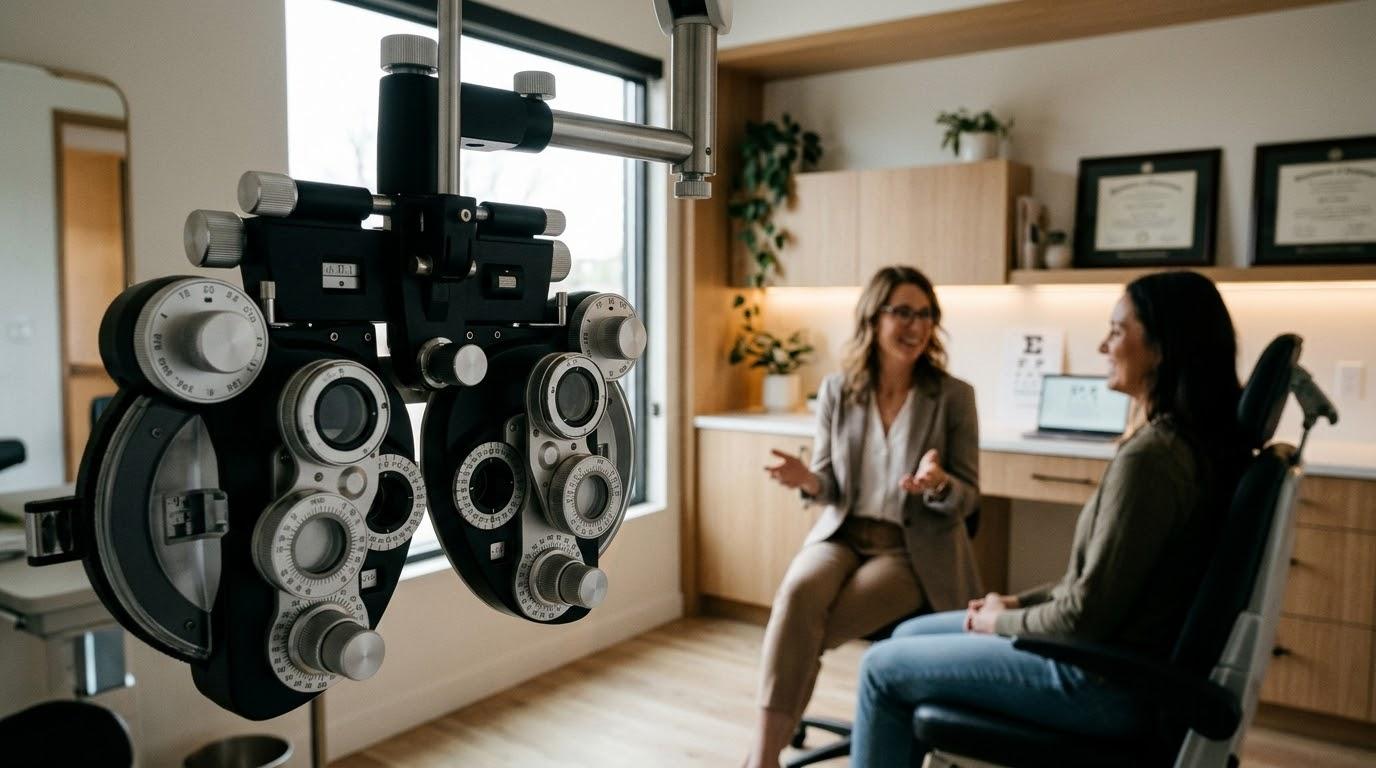

SEO for optometrists is the work of making an eye care practice easy to find, trust and book in Google. In our November 2026 review of “optometrist” results in six U.S. cities, independent practices held 44 of 60 top-10 slots and optical chains held 7 of them. We would start with medical eye care pages, not frame prices.
Key takeaways
- Independent practices held 44 of 60 top-10 slots for “optometrist” searches in six cities and optical chains held 7, so organic search is winnable. Directories and health systems held eight more.
- Build medical eye care pages first: 28 of 31 ranking independent sites have a URL for a medical eye topic, while only 1 of 31 homepages names a frame brand.
- State the doctor’s credential, the insurance rules and the booking path on every service page. Only 18 of 31 homepages name an optometrist credential.
What do “optometrist” search results look like in six U.S. cities?
Optical chains appear in “optometrist” results but do not dominate them. On November 10, 2026 we requested Google’s top 20 organic results for “optometrist” plus a city (Austin, Denver, Phoenix, Charlotte, Columbus and Portland) through DataForSEO, using United States, English and desktop settings; Google returned 19 per query. That gave 114 results, 60 of them in the top 10 positions. We labeled each by domain: optical chain meant LensCrafters, Target Optical, MyEyeDr., Visionworks or America’s Best, and independent meant any practice site not labeled chain, directory, health system or unknown, including large physician-owned groups; directories, health systems and two social profiles were labeled separately.
Independents held 79 of the 114 results, 44 of the 60 top-10 slots and the first position in 5 of the 6 cities. Optical chains held 13 results, 7 top-10 slots and no first position. Independents therefore held more than six times as many top-10 slots as chains, so a chain’s name does not stop an independent site from ranking first for the query. The label hides a lot: a physician-owned group counts as independent, so a single-office practice may face a larger group, not a chain.
Directories are rivals a practice should work with rather than fight. They held 5 of the 60 top-10 slots: three for Zocdoc and two for the insurer Vision Service Plan (VSP), whose pages our labels count as directories. VSP’s Columbus page was also the only first position not held by an independent. A practice will not outrank those sites in every city, so it needs an accurate listing in each plan’s directory and a site that turns that visit into a booking.
For the site audit we took up to six independent domains per city, 36 in all. Five were unreachable or blocked, so we read 31 homepages, plus their sitemap and homepage-link URLs. The sample includes ophthalmology and multi-doctor eye practices because they rank for the same query. Text and markup checks read homepages only and cannot see JavaScript-rendered content. We did not test whether those five domains differ from the rest.
The pulls cover six cities on a single day. The city was typed into a national desktop search. That is not what a local searcher sees, and it is not a “near me” query, so read the pulls as a repeatable snapshot, not a copy of patient results. Labels come from the domain alone, and the data shows who ranks, not why.
Why can independents beat chains in optometry SEO?
Optical chains rank for “optometrist” searches with store and location pages. Judging by URLs and titles, not page text, all 13 chain results in our pulls are location pages: one store or a city or state hub, on addresses such as locations.myeyedr.com and local.lenscrafters.com. Their titles read like “Eye Exams in Fountain Square on East Bell Road”, which tells a searcher where a store is. The best chain placements were third in Denver, third and fourth in Phoenix and fifth in Austin, so chains are beatable, not absent.
The local pack points the same way. Its 18 listings across the six pulls include no business named after one of the five chains, though we matched names only and did not check ownership. Local SEO for optometrists therefore starts with a complete Google Business Profile; our local SEO guide for healthcare and local SEO service cover that.
Where should an independent not compete? In our view, on frames. Only 1 of the 31 independent homepages we read names a frame brand, and we would keep it that way. A single practice rarely matches a chain’s inventory or promotional pricing, so a frame page fights on the chain’s strongest ground. We did not pull glasses or frame queries, so this is judgment, not a measured result. The exam, the medical visit and the doctor are what an independent site can describe in depth. Before copying our conclusion, pull the top 10 for your own city and mark which results are store pages, directories and independents.
Why are medical eye care pages the strongest asset?

Medical eye care is the page type we would build first. Of the 31 independent sites we read, 28 (90%) have a non-blog URL for a medical eye topic such as dry eye, glaucoma, diabetic eye exams, macular disease or cataract. On 27 of the 31 (87%), the homepage also mentions medical eye care. The sample includes ophthalmology practices, which naturally have such pages, but six homepage titles name ophthalmology or cataract surgery. Even if all six have a medical URL, at least 22 of the other 25 sites do too.
Why start there rather than with contact lenses or frames? First, in our view a patient with a painful red eye or a diabetes diagnosis is more likely to search by condition than by shop, and the chain pages we saw are built around stores. Second, medical pages let the doctor’s training show. Third, medical visits follow different coverage rules from routine exams, which a page can explain and a location listing cannot.
Children, myopia and urgent visits are thinner than medical eye care, which 27 of 31 homepages mention: 15 mention children, 12 mention myopia and 16 mention emergency or urgent eye care. That suggests an opening for a practice that offers the service, though the data cannot say whether searchers want those pages. Do not publish a myopia page without a doctor who provides that care. On every page, say who the visit is for, what happens, how it is billed and when the practice refers the patient elsewhere. Our service page optimization guide covers the template, and our on-page SEO service optimizes service and condition pages.
How should a practice answer the questions patients ask Google?
Patient questions are decisions, not keywords, and each belongs on the page where the decision is made. Two of our six pulls, Austin and Columbus, returned a People Also Ask box. Between them, the boxes asked whether optometrists are doctors, why someone would choose an optometrist over an ophthalmologist, what a visit costs and where to find emergency eye care. Austin’s box also asked about Walmart eye doctors, including what a visit there costs.
Read together, the questions voice five doubts: is this a real doctor, which doctor do I need, what will it cost, where do I go today and is a retail counter enough. In our view, answer each where the decision happens, not on one generic FAQ page. Put credentials on the doctor’s page and the optometrist-versus-ophthalmologist explanation on the exam and medical pages. Put cost on an insurance and fees page, and open the urgent-care page with the phone number. List the symptoms that call for emergency care; MedlinePlus names chemical exposure, a painful red eye and any change in vision among them.
Two answers need care. On cost, publish the self-pay exam fee if the practice can, or explain exactly how the fee is set, because a page that discusses price without a number leaves the question half answered. This guide quotes no typical price, since none of our data measures fees. On the Walmart questions, do not compare. A single practice rarely wins a price contest with a retailer, so say what your exam includes and what follow-up looks like, and make no claim about another provider’s quality.
How should an optometrist’s site show credentials, insurance and booking?
Start with the credential line, because fewer homepages state it than mention insurance or offer booking. Only 18 of 31 homepages (58%) name an optometrist credential: O.D., doctor of optometry or optometrist. Ophthalmology practices might be expected to pull that number down, but four of the six ophthalmology-titled homepages name the credential; among the other 25, 11 omit it. Patients ask whether optometrists are doctors, and a bio that says only “Dr.” leaves that unanswered.
Optometrists typically need a Doctor of Optometry degree, which takes 4 years to complete, according to the Bureau of Labor Statistics, and every state requires a license. State the degree, the optometry school, the license and any residency on each doctor’s page. Credentials were thin in our audit of 29 orthodontic sites too, where only 3 homepages named the American Board of Orthodontics. Our E-E-A-T checklist for medical websites covers the other trust signals.
Insurance deserves its own page. It appears on 22 of 31 homepages (71%), yet only 18 sites (58%) have an insurance URL, so at least four mention coverage without giving it a page. We would build one insurance page that lists accepted plans and, more usefully, separates routine exams from medical visits, because payers treat them differently. Medicare.gov says Original Medicare does not cover routine eye exams for glasses or contact lenses and that the patient pays all costs for them. Our guide to near me and insurance keywords covers plan names.
Booking and phone are baseline, not an edge: a booking or appointment-request phrase appears on 26 of 31 homepages (84%) and a click-to-call link on 29 (94%). We read homepages only, so check that medical and urgent pages carry the phone number and booking link too.
Treat markup as hygiene, because our data cannot show that it moves rankings. Ten of the 31 homepages carry a medical or Optician type, and three more use an Optometric type that our check did not count. FAQPage markup is the type we would not prioritize. None of the 31 homepages has it, and Google’s documentation says the FAQ rich result is no longer shown in Search results (entry dated June 15, 2026). This page still carries FAQPage markup, as harmless structure and not as a ranking lever. Our medical schema markup guide lists the types.
How do you measure optometry SEO by booked exams?
Measure booked and attended exams, not traffic. Searches that contain the practice or doctor name mostly come from people who already know the practice, so they inflate traffic reports and say little about search performance. We would judge optometrist SEO on new-patient exams that start with an unbranded search. Four steps connect search to those exams:
- Define booked and attended exams in the scheduling system, and tag new-patient exams apart from recall visits.
- In Search Console, filter the Performance report by page path for medical, pediatric and urgent pages, exclude queries containing the practice name, and compare full calendar months.
- Log calls and online booking requests by landing page, keeping patient details out of analytics tools, as our guide to analytics and call tracking for clinics describes.
- At booking, ask each new patient how they found the practice, then compare exams booked with exams attended, month by month.
Search Console shows impressions and clicks, not patients, and a phone call that books an exam may never be tied to a query. If a page rewrite and a review drive land in the same quarter, the data cannot say which moved bookings, so treat any change as correlation. This guide gives no expected number of booked exams, because none of our data measures patient outcomes.
FAQ
Are optometrists doctors in the United States?
Yes, as doctors of optometry, not medical doctors. Optometrists typically need a Doctor of Optometry (O.D.) degree, which takes 4 years to complete, according to the Bureau of Labor Statistics, and every state requires them to be licensed. A practice page should state the degree and the license plainly, because patients search for exactly this answer.
Why would you go see an optometrist instead of an ophthalmologist?
Choose by the problem. The Bureau of Labor Statistics says optometrists diagnose, manage and treat eye conditions and prescribe glasses and contact lenses, and refer patients to other providers when needed. The American Academy of Ophthalmology describes an ophthalmologist as a medical doctor who handles diagnosis, management and surgery of eye disease. Ask any practice what it treats in-house and when it refers.
What does it cost to see an optometrist?
There is no single price, and this guide quotes none. The cost depends on the practice’s fee, the type of visit and the patient’s coverage. Medicare.gov says Original Medicare does not cover routine eye exams for glasses or contact lenses. For eligible patients with diabetes, Part B covers a yearly diabetic retinopathy exam. After the Part B deductible, the patient pays 20% of the Medicare-approved amount for the doctor’s services.
Where can I find emergency eye care?
Seek emergency medical care for the situations MedlinePlus lists. These include a scratch, a cut or something that has gone into the eyeball, any chemical in the eye, a painful red eye and any change in vision. For a chemical splash, MedlinePlus says to flush the eye right away with a gentle stream of cool tap water and to keep flushing for at least 15 minutes. For other urgent concerns, call a nearby eye care practice; 16 of 31 audited homepages mention urgent or emergency eye care.

Written by
Oleg Silin
Head of SEO & Content
Agency co-founder who leads SEO and content for 20+ clients and 30+ websites, specializing in recovering traffic lost to Google algorithm updates.